
You are here: Home » Traceability & Recall Made Simple
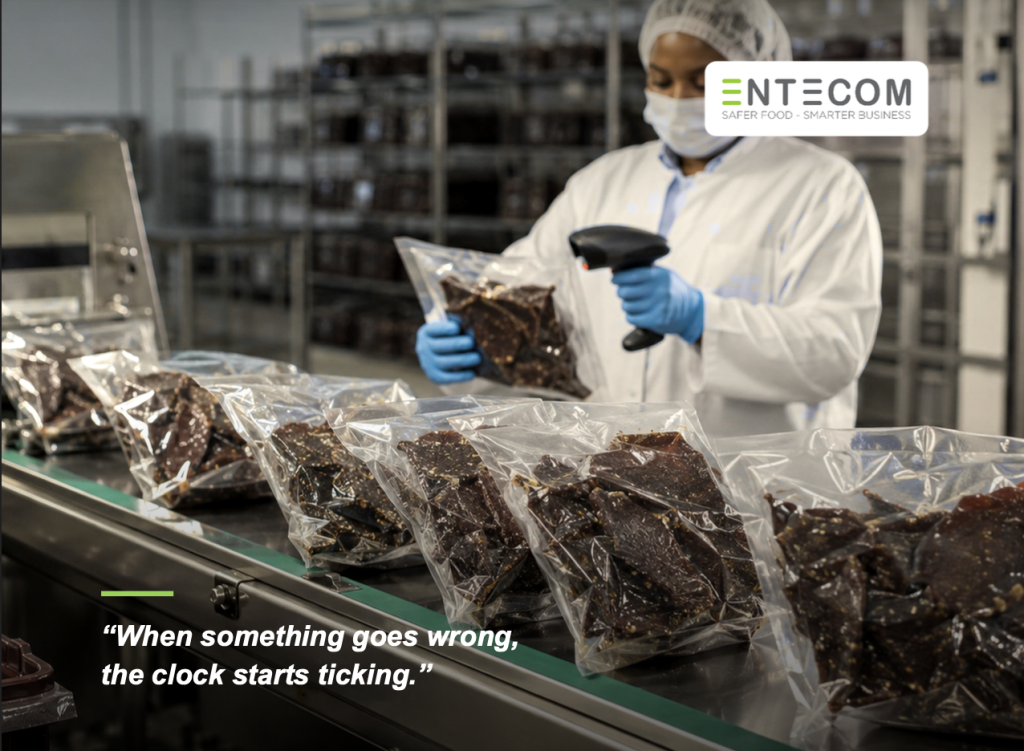
“When something goes wrong, the clock starts ticking.”
Entecom eBook · October 2026
Building a System That Works When You Need It Most
A practical guide to testing traceability, mass balance and recall readiness — aligned to BRCGS Issue 9, FSSC 22000 Version 7 and South Africa’s Consumer Protection Act.
This eBook helps food businesses test whether their traceability and recall systems would actually work under pressure — not only whether the records exist. It is a practical, referenced guide that technical, quality, production and senior management teams can use to design their next traceability test or mock recall, written to support — not replace — BRCGS Issue 9, FSSC 22000 Version 7 and the recall provisions of South Africa’s Consumer Protection Act.
This guide is based on the Entecom webinar “Traceability & Recall Made Simple: Building a System That Works When You Need It Most”, presented by Lyndri Fourie from Entecom on 15 September 2026.
Almost every food business already has batch numbers, receiving, production and dispatch records, a traceability procedure and an annual test or mock recall. The useful question is not whether these exist, but whether they would work if something went wrong today: for a batch you don’t normally test, traced forwards from an ingredient, with the quantities accounted for — and run by someone other than your usual technical person.
“A traceability system isn’t tested when you can find the paperwork. It’s tested when something goes wrong — and the clock starts ticking.”
This guide applies to any food business operating a traceability and recall system, whether certificated, working toward certification or supplying customers who audit against their own requirements. It is intended for Technical and Quality Managers, production and dispatch leaders, and anyone named in a recall procedure. The worked example uses FTB Foods (Pty) Ltd (“Follow the Batch Foods”), a fictional biltong manufacturer created for training purposes. This guide is not an audit tool and does not prescribe a software system.
In short, both certification schemes want traceability proven in both directions with the numbers adding up, and a recall process that has actually been rehearsed. South African consumer law adds further duties once affected product is in consumers’ hands.
The summaries below are Entecom’s own plain-language interpretation, not the official wording. Always consult the current scheme documents and legislation for the exact requirements.
| Source | Key requirements |
|---|---|
| BRCGS Issue 9Clause 3.9 | Treats traceability as a core requirement. Sites must be able to link every raw material — primary packaging included — through any part-used stock and rework to the finished product. At least once a year, each product group should be traced in both directions, with quantities reconciled and the supporting records summarised. The expectation is that this can be done within about four hours. |
| BRCGS Issue 9Clause 3.11 | Sites need a written withdrawal and recall procedure that can be activated at any hour. It should name who to contact, explain how product will be recovered and how stock will be reconciled. The procedure itself must be tested every year, and the certification body informed within three working days if a recall happens. |
| FSSC 22000 V7ISO 22000:2018 | The organisation must be able to link what it receives from suppliers to where its finished product first goes, and check the system works — reconciling quantities where relevant (8.3). Named people need the authority to start and run a recall, with clear arrangements for notification and handling, proven through a practice recall (8.9.5). The certification body must hear about any public recall or withdrawal within three working days (2.5.17). |
| Consumer Protection Act 68 of 2008Section 60 | Together with the NCC’s 2012 recall guidelines, the Act expects businesses to inform the National Consumer Commission in writing, ideally before a recall begins and no later than two days after. Notices to consumers should identify the product and the problem plainly, show a photo of the product and tell people exactly what to do next. |
Batch numbers, labels and dispatch notes are only the tools. The purpose of traceability is simpler: if I give you something, can you tell me where it came from, what happened to it, and where it went?
We trace because that information must eventually support a decision — when a supplier phones about an ingredient, a customer complains or a food safety risk emerges.
◀ The same pathway must work in reverse ▶
Figure 1 — Four questions every traceability system must answer, in both directions along the batch pathway.
The scenario. FTB Foods is asked to run a routine traceability test on Traditional Sliced Biltong, batch BLT-040926, produced on 4 September 2026. The finished-product record is the most dependable starting point. And because the person who usually runs the test — call her Susan — is unavailable, the team must follow the records rather than one person’s knowledge.
◀ Trace backwards
BLT-040926
Trace forwards ▶
SP-2918
Figure 2 — Backwards shows what went into a product. Forwards shows how far the impact of one ingredient lot could spread.
Forward tracing is often harder, because one ingredient lot can run across several production runs and batches — which is why an annual test that only traces one convenient batch backwards doesn’t prove the whole system works. Sequence matters too: if Spice Lot A ran out at 11:00 and Lot B was opened, the production date alone can’t show which product was exposed to which lot.
The identifier may change from receiving to dispatch; what cannot disappear is the link between the records. Technology — whether Excel, an ERP system or EO — makes those links faster to find, but it cannot create information that was never captured at the handover.
Finding the batch tells you where it went. Mass balance tells you whether the whole story makes sense — and unexplained differences often point to stock, waste or rework you haven’t found yet.
Raw meat received 1,000 kg
700 + 250 + 40 + 10 = 1,000 kg
Figure 3 — Each figure must be supported by evidence, not simply made to add up.
Being 10 kg short and deciding “that must have been samples” is not reconciliation. And if you account for 93%, the percentage is not the explanation — it tells you to ask what happened to the other 7%. For FTB Foods, drying, trimming and sampling mean 100 kg of raw meat will never become 100 kg of biltong. What matters is knowing what is normal for your own process, and telling expected, supported process loss apart from unexplained variance.
If I had to explain these numbers to someone tomorrow morning, could I do it confidently, using evidence?
FTB Foods traces both ways, reconciles the quantities and is ready to sign off. Then the auditor asks: “What about the spice?” The spice was used, but its lot was never recorded on the production record — so the team can neither prove which lot went into BLT-040926 nor show where else it was used. A minor ingredient does not mean minor traceability importance. Decide scope deliberately — main and minor ingredients, relevant packaging, contact materials and rework — based on relevance, risk and requirements, not convenience.
| Auditor red flag | What it looks like in practice |
|---|---|
| Receiving to production | The supplier lot is captured at receiving but never reaches the production record. |
| Rework and mixed lots | Rework origin is lost, or several lots run together with no record of the changeover. |
| Dispatch | Customer, product and quantity recorded — batch number missing. |
| One direction only | Backwards works well; forwards from a raw-material lot is a struggle. |
| Weak evaluation | The same easy product every year, unexplained differences accepted, or a slow test still marked “successful”. |
| Person dependency | Good records everywhere, but only one person knows how to connect them. |
16:07
Friday afternoon
Figure 4 — Friday, 16:07. The usual people may no longer be available.
Susan has gone home, the Production Manager is unavailable and product is already moving through customers’ distribution. Then the spice supplier calls.
Stop. The supplier just called.
“Do not use lot SP-2918. Salmonella has been detected.”
The traceability test is over; this is now a recall. Knowing where the product went is not the same as managing the incident — the business must now act on that information.
| Step | What it involves |
|---|---|
| 01 Confirm | Which lot is affected, have we used it, and which products and batches could be involved? |
| 02 Contain | Secure affected stock still under our control so nothing else leaves site. |
| 03 Decide | Who has authority to initiate the recall — and who holds it when that person is absent? |
| 04 Notify | Customers, the certification body and regulators, including the NCC where consumer product is involved. |
| 05 Recover | Control product on site, with customers or returned, and reconcile what comes back. |
| 06 Verify | Did the message reach the right people, and has all affected stock been controlled? |
Practical tip · One exercise can test both
Traceability tests the information pathway; recall tests what the business can do with it. Rather than running two exercises, extend one: trace backwards and forwards, reconcile, then introduce the supplier’s call and let the recall procedure run — authority, contact details, communication and verification. If your exercise stops at “we found the customer”, next time let the phone ring.
| Clock | Their question | What they need from you |
|---|---|---|
| Auditor | “Show me how you identified all affected batches.” | Evidence that the system found the complete scope |
| Customer | “We have 36 cases in our DC and 14 stores. What do we do?” | Precise batches, quantities, locations and required action |
| Consumer | “I bought this yesterday. My child ate some. Is it affected?” | Clear product identification, risk information and instructions |
Every answer starts with the same traceability information, and precision cuts both ways: a vague scope forces customers to isolate too much stock, while a scope narrowed without evidence can leave affected product in someone’s home.
Most exercises run under comfortable conditions, with the usual person in the room. Real incidents don’t make appointments. The Friday 4 PM Test asks whether the people actually on site could identify the affected product, access the records, find someone with authority, activate the recall and communicate accurately. If the answer depends on one person, you have a single point of failure — and the first time you discover your backup can’t log in should not be during a real recall.
Use these questions as a self-check, then choose one thing to test differently in your next exercise.
| Area | Self-check | Next time… |
|---|---|---|
| Scope | Is every relevant input linked, not just the obvious ones? | Choose a minor ingredient and follow it forwards. |
| Links | Can we trace forwards as well as backwards, including rework? | Make rework and lot changeovers part of the test. |
| Quantities | Can we explain every difference, including normal process loss? | Don’t just calculate the percentage — explain it. |
| Recall | Have we tested the recall itself, not only the trace? | Let the phone ring and run the procedure. |
| Contacts | Are recall contacts confirmed to work, not just listed? | Call them during the exercise. |
| People | Could someone other than the usual person run the system? | Send Susan home — just for the exercise. |
| Theme | BRCGS Issue 9 | FSSC 22000 V7 | What an auditor looks for |
|---|---|---|---|
| Traceability system | Linked records from supplier to customer, packaging and rework included (3.9) | Links from supplier to first customer (ISO 22000 8.3) | Every relevant input linked at each handover |
| Testing & mass balance | Yearly two-way test with reconciled quantities (3.9.3) | System checked, with quantities reconciled where relevant (8.3) | Supported reconciliation and an honest evaluation |
| Recall | Procedure ready around the clock and tested yearly (3.11.2–3.11.3) | Named decision-makers and a rehearsed recall (8.9.5) | Delegated authority that works when key people are absent |
| Notification | Tell the certification body within three working days (3.11.4) | Tell the certification body within three working days (2.5.17) | Plus the NCC under CPA s60 |
Don’t just test whether your system can pass. Test whether it can teach you something.
This eBook was developed by Entecom for food businesses operating, or working toward, BRCGS and FSSC 22000 certification. FTB Foods (Pty) Ltd and all scenario details are fictional. It is intended as practical guidance and does not replace the official text of any certification scheme or legislation, which should always be consulted directly for compliance purposes.