
You are here: Home » Food Safety & Quality Culture – Beyond the Annual Survey
Entecom eBook · September 2026
Beyond the Annual Survey
A diagnostic guide to reading the evidence already inside your Food Safety Management System — aligned to BRCGS Issue 9, FSSC 22000 Version 6 and the GFSI position paper on a culture of food safety.
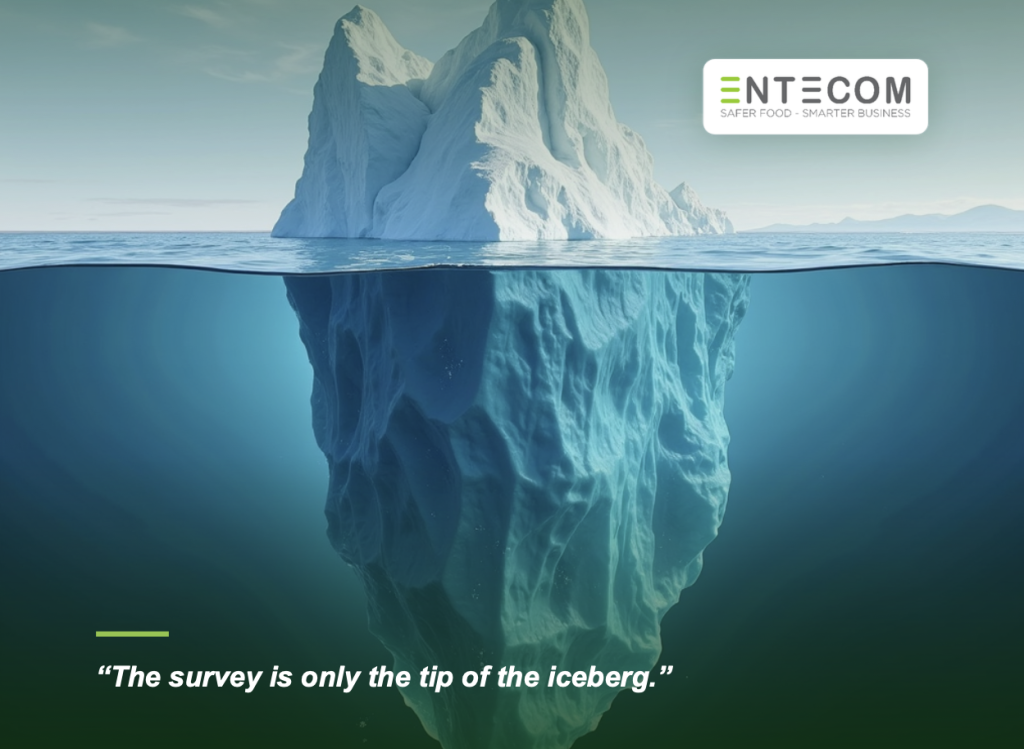
“The survey is only the tip of the iceberg.”
| Published | Issue | Changes |
|---|---|---|
| September 2026 | 1 | First publication, developed from the Entecom “Food Safety & Quality Culture: Beyond the Annual Survey” webinar. |
01 · Purpose
This eBook exists to help food businesses look beyond the annual Food Safety & Quality Culture survey and interpret the much wider body of evidence already generated by their Food Safety Management System (FSMS). It translates the themes of Entecom’s “Food Safety & Quality Culture: Beyond the Annual Survey” webinar into a structured, referenced guide that quality, technical and senior management teams can use directly, and revisit as culture is discussed at management review.
It is written to support — not replace — the culture-related requirements of BRCGS Global Standard Food Safety Issue 9 and FSSC 22000 Version 6, and to align with the Global Food Safety Initiative’s (GFSI) Position Paper on a Culture of Food Safety (Version 2.0, 2026).
02 · Introduction
When organisations talk about Food Safety & Quality Culture, the conversation often moves quickly to an annual employee survey, an action plan, a measurable objective and a review date. Those activities can absolutely form part of a culture programme — but they rarely give the complete picture.
Culture is not something that exists only in a questionnaire. It is present every day: in the concerns people report, in the issues they choose not to report, in the way supervisors respond to mistakes, in whether corrective actions prevent recurrence, and in what people do when production pressure increases.
“The survey is only the tip of the iceberg.”
This guide is not about abandoning surveys — they remain a genuinely useful way of understanding employee perceptions at a point in time. It is about placing the survey in its correct context, and exploring the wider evidence that already exists throughout the FSMS: audits, non-conformances, corrective actions, near misses, training records, complaints and employee feedback. None of these records proves culture on its own. But when the evidence is connected, patterns identified and better questions asked, it can reveal where further investigation and improvement is needed.
03 · Scope
This guide applies to any certificated or certifying food business seeking to strengthen how it evidences and improves Food Safety & Quality Culture under BRCGS Issue 9 (clauses 1.1.1 and 1.1.2) or FSSC 22000 Version 6 (Additional Requirement 2.5.1, Food Safety Culture). It is intended for Quality Managers, Technical Managers, site leadership teams and anyone chairing management review, and can be used alongside — not instead of — the site’s existing culture plan, survey and objectives.
This guide does not replace certification requirements, does not constitute an audit tool, and does not prescribe a maturity model or software system. It is a practical framework for interpreting evidence that most FSMS already generate.
04 · Standards Requirements
Neither BRCGS nor FSSC 22000 treats Food Safety Culture as a once-a-year survey exercise. Both schemes expect culture to be actively planned, evidenced, monitored and continually improved — and GFSI’s global position paper reinforces the same view.
Clause 1.1.1 requires the site to hold a documented policy, signed by the person with overall responsibility for the site, that includes a commitment to continuously improve the site’s food safety and quality culture and is communicated to all staff.
Clause 1.1.2 goes further: senior management must define and maintain a clear plan for the development and continuing improvement of food safety and quality culture, including measures needed to achieve positive culture change. As a minimum, the plan must be built around defined activities covering:
BRCGS’s own interpretation guidance is explicit that culture “relies not just on measurables and specifics but an ethos and values felt by people at all levels of the site,” and that analysis of root causes across many non-conformities shows a proactive, positive culture “can make all the difference in the effectiveness of the food safety and quality plan and its consistent implementation.” This is precisely the evidence-based, whole-system view this guide is built around.
FSSC 22000 requires organisations to establish, implement and maintain a Food Safety Culture Plan that includes objectives, activities addressing communication, training, feedback and performance measurement, and an evaluation of the effectiveness of those activities, reviewed and updated at defined intervals. As with BRCGS, the requirement is deliberately outcome-focused rather than prescriptive about the exact mechanism used — allowing the diagnostic approach in Section 5 of this guide to sit comfortably alongside an existing FSSC culture plan.
GFSI’s updated position paper defines food safety culture as “a concept existing in all food businesses relating to the deeply rooted beliefs, behaviours, values and assumptions that are learned and shared by all employees, and which integrate to impact the food safety performance of the organisation.”
The paper organises culture into five dimensions across two interdependent tiers:
| Tier | Dimension |
|---|---|
| Organisational Foundations | Company Values, Vision & Mission |
| Organisational Foundations | People: Commitment, Empowerment & Accountability |
| Manifested Cultural Essentials | Hazard & Risk Awareness |
| Manifested Cultural Essentials | Consistency for Food Safety (FSMS application, measurement & records) |
| Manifested Cultural Essentials | Adaptability, Change & Continuous Improvement |
GFSI is explicit that culture and formal systems are not separate concerns: “in high-performing organisations, systems and culture operate in concert to sustain food safety outcomes.” This is the same principle this guide applies throughout Section 5 — reading FSMS evidence as a window into culture, rather than treating the two as separate programmes.
05 · Guidance for Implementation
Consider two food manufacturing facilities. Factory A passed its audit, completed its annual culture survey, has an action plan, reviews its objectives and has trained its staff. Factory B has done exactly the same. Which factory has the stronger Food Safety & Quality Culture?
The honest answer is that it cannot be determined from this information — not because of missing experience or a missing audit report, but because none of it describes how people actually behave. Both organisations have shown that a management system exists. Neither has shown what its culture is.
| Management System | Culture | |
|---|---|---|
| Tells us | What is planned and expected | How people behave when plans meet reality |
| Evidenced by | Policies, procedures, training records, audit scores | Decisions made when nobody is watching |
| Answers | “Do we have a programme?” | “What does daily operation reveal about us?” |
The two are not competitors. A strong management system creates the structure for good culture, and a strong culture helps people consistently apply that system. The more useful question is therefore not “Do we have a good system?” or “Do we have a good culture?” but: “Is our system helping to create the culture we want?”
The iceberg is one of the clearest ways to picture this distinction. Above the waterline sit the things that are easy to observe and audit: the survey, policies, training records, objectives, management review, and internal and external audit findings. All of this is necessary — the standards expect it — but it only tells us what has been planned.
Above the waterline · What is planned — easy to audit
Below the waterline · What people actually do — hard to see
Figure 1 — The Food Safety & Quality Culture Iceberg: the survey is one visible layer among many.
Below the waterline sit the characteristics that are harder to see, but which strongly influence what happens on the floor: leadership, trust, communication, reporting, decision-making under pressure, ownership, psychological safety, recognition, behaviour and continuous improvement. Two factories can have identical procedures, training records and audit scores, and even similar survey results, and still have very different cultures — because those activities describe what was planned, not what people do every day.
Food Safety & Quality Culture is not measured through a single instrument. It is diagnosed — in the same way a doctor does not diagnose health from one number, but looks at multiple indicators, asks questions, identifies patterns and considers history before reaching a conclusion.
This guide organises the evidence already sitting inside most FSMS into eight diagnostic lenses. A lens does not supply an answer; it changes the way the evidence is looked at. The eight lenses are not isolated — a breakdown in communication affects reporting, poor reporting reduces learning, and weak recognition discourages ownership, so they should be read together rather than scored individually.
Figure 2 — The Eight Diagnostic Lenses of Food Safety & Quality Culture.
| Lens | Guiding question | Existing FSMS evidence |
|---|---|---|
| Leadership | What do leaders’ actions — not their policies — reinforce? | Leadership walkabouts; questions asked on the floor |
| Behaviour | What do people do when nobody is watching? | Behaviour observations; repeated patterns |
| Reporting | Do people report concerns early, or only when noticed? | Near-miss numbers, interpreted in context |
| Communication | Was the message understood, not just delivered? | Toolbox talk completion vs. recall of key messages |
| Recognition | What behaviour does the organisation celebrate? | Employee suggestions; recognition of reporting |
| Learning | Does the organisation correct problems, or learn from them? | Repeat non-conformances and their root causes |
| Trust | Do people feel safe raising concerns or admitting mistakes? | Reporting rates, read alongside psychological safety |
| Continuous Improvement | Are corrective actions verified as effective, or just closed? | CAPA effectiveness checks; recurrence rates |
Evidence does not equal culture — evidence reveals culture. Three repeat non-conformances do not automatically mean a poor culture, just as a small number of reported near misses does not automatically mean a healthy one. Evidence tells an organisation where to become curious, not what conclusion to reach.
Figure 3 — The diagnostic cycle: from raw FSMS evidence to sustained improvement. Improvement generates new evidence — the cycle returns to Step 01.
This is not a straight line — it is a cycle. Every improvement creates new evidence, which is why Food Safety & Quality Culture should be treated as a continuous process of observing, interpreting, discussing and improving, rather than a once-a-year exercise.
The same symptom can have several plausible cultural explanations, which is exactly why it should prompt a conversation rather than a conclusion:
| Symptom observed | Possible cultural drivers to investigate |
|---|---|
| Low reporting of near misses | Trust · Communication · Recognition |
| Repeat non-conformances | Learning · Leadership follow-through · Continuous improvement |
| Poor GMP compliance | Behaviour norms · Communication · Recognition |
| Weak employee participation | Leadership · Trust · Communication |
| Employees concealing mistakes | Trust · Psychological safety · Leadership response to error |
The discipline here is to keep asking the standard root-cause question (“What caused this event?”) and add a second, complementary question: “Which cultural lenses should we also investigate?” The first explains the event; the second explains why the organisation was, or was not, able to prevent it recurring.
An operator notices that incorrect labels have been delivered to the production line. Nothing has been packed yet; nothing unsafe has left the factory. Two things can happen next.
Scenario A
The operator says nothing, assuming someone else will notice or that it isn’t their responsibility.
Scenario B
The operator immediately reports the issue. Production stops, the labels are removed, and the issue is investigated before it becomes a complaint or recall.
The operator’s decision in Scenario B does not reveal one cultural characteristic — it reveals several at once: reporting, trust, ownership, leadership, communication and learning. A single everyday moment can be a genuinely rich piece of cultural evidence.
The story does not end with the report, either. If both organisations report the same incident, but one supervisor thanks the operator for speaking up while the other asks why they are “creating more paperwork,” the identical event tells two very different cultural stories. This is why evidence should always be read in context, never in isolation.
A dashboard, KPI report or trend chart does not improve culture on its own — conversations do, and actions do. The value of any culture-related data lies entirely in the questions it prompts management to ask next:
| If the evidence shows… | The better question is… |
|---|---|
| Repeated supplier labelling non-conformances | Why didn’t our previous corrective actions prevent recurrence? |
| Only a handful of near misses reported all year | Do our employees feel comfortable reporting? |
| Audit scores consistently above 95%, but the same findings recur | Are we auditing for compliance, or auditing for improvement? |
| 98% training completion | Can employees consistently demonstrate competence where it matters? |
None of these questions have a single correct answer. Their purpose is to move the conversation from “we have a number” to “we understand what is driving the number” — which is where meaningful, sustained improvement begins.
Food Safety & Quality Culture does not belong to the Quality department. Quality and Technical teams can facilitate, analyse trends and coordinate investigation — but they cannot build culture alone. Culture is built through thousands of everyday decisions made across the organisation.
| Role | Contribution to culture |
|---|---|
| Senior Management | Sets direction and priorities; allocates resources; demonstrates through action what really matters |
| Supervisors | Coach, give feedback and recognise good behaviour in the moment |
| Quality & Technical Teams | Provide structure, trend analysis and facilitation — not sole ownership |
| Production Teams | Create culture through daily behaviour, reporting and adherence under pressure |
| Every Employee | Contributes through reporting, ownership and continual improvement |
Quality manages the system. People create the culture. Leadership decides which behaviours become normal.
Improving Food Safety & Quality Culture rarely depends on one large initiative — it depends on small, consistent actions repeated over time. None of the following require a new standard, a new software system or a major culture programme:
06 · Alignment
The diagnostic approach in Section 5 is not an additional standard or a replacement for certification requirements. It is a practical way of organising evidence that BRCGS, FSSC 22000 and GFSI already expect food businesses to generate, review and act on.
| Theme | BRCGS Issue 9 | FSSC 22000 V6 | What an auditor looks for |
|---|---|---|---|
| Leadership | Senior management commitment (1.1.1) | Food Safety Culture Plan ownership | Visible leadership and follow-through on concerns raised |
| Communication | Effective communication of policy (1.1.1) | Awareness activities within the culture plan | Employees who can explain expectations, not just recite them |
| Measurement | Assess and continually improve culture (1.1.2) | Objectives and monitoring of culture activities | Trends, evidence, and demonstrable continual improvement |
| Continual Improvement | Review of activity effectiveness, at least annually (1.1.2) | Evaluation of culture plan effectiveness | Verification that corrective actions actually prevented recurrence |
In short: this guide does not change the standards. It helps organisations get more value from the requirements they are already certified against.
07 · Key Takeaways
Food Safety & Quality Culture isn’t another programme. It’s the way we use the programmes we already have.
08 · References
This eBook was developed by Entecom for organisations working toward BRCGS and FSSC 22000 certification. It is intended as practical guidance and does not replace the official text of any certification scheme, which should always be consulted directly for compliance purposes.