Moving Beyond Compliance to Proactive Food Safety Management
If you’re reading this, you’re likely familiar with the term Environmental Monitoring Programme, or EMP. This guide aims to consider EMP not only as a compliance requirement but also as a crucial diagnostic tool for your facility’s microbial health. Whether you are complying with the Department of Health’s R638 regulations, meeting Global Food Safety Initiative (GFSI) recognised standards like FSSC 22000 or BRCGS, or simply seeking to protect your brand from the risks of a product recall, understanding your food safety environment is vital.
In the following pages, we will go beyond theory. We will clarify what it truly means to monitor microorganisms in a food processing setting and provide a practical, 8-step plan to establish an effective programme.
Firstly, it’s important to recognise the changing landscape as the foundation of our prerequisite programmes (PRPs) evolves. ISO/TS 22002-1:2009 is has been replaced by two new standards.:
- ISO 22002-100:2025: The new generic PRP standard, aligning with Codex HACCP 2023 and expanding on validation, food defence, and food fraud.
- ISO 22002-1:2025: The sector-specific PRP standard for food manufacturing, adding detail for higher-risk areas like zoning, allergens, and rework.
Together, these form the new basis of PRP compliance. This guide will help you understand how to adjust your systems to stay ahead of these changes.
Let’s begin.
Part 1: The Foundation – Why We Can’t Rely on Our Eyes
The Invisible Enemy
Why sample the environment? A clean facility isn’t enough because pathogens like Listeria, Salmonella, and E. coli are microscopic and invisible. They don’t show signs like smell or colour, so a spotless look doesn’t guarantee safety. Traditional senses can’t detect them; scientific methods are needed to monitor and translate the invisible microbes into manageable data.
Consider this:
- Surface A and Surface B might appear identical after cleaning, both seemingly passing a visual inspection.
- However, a contact plate from Surface A could show a low microbial count—indicating it is truly clean.
- In contrast, a contact plate from Surface B might reveal substantial bacterial growth—a potential contamination hotspot, even if it looks clean.
Relying only on visual inspection is a trap. The only way to tell if a facility is ‘clean’ or ‘safe’ is through scientific monitoring. Without an EMP, contaminated surfaces could infect the product for weeks before the problem is detected.
Our key takeaway is this: The enemy is invisible. It is like boxing a ghost. We cannot manage what we cannot measure.
Therefore, our approach must be twofold:
- Control: We need robust procedures—cleaning, cooking, cold chain—to control bacteria.
- Verify: We must verify that those controls are actually working. That is the specific role of an Environmental Monitoring Programme. It is our proof that the invisible enemy has been defeated.
Part 2: The Rulebook – Where Do the Requirements Come From?
As professionals, we are guided by customer requirements, local regulations and international standards. The primary reference point for food safety globally is the Codex Alimentarius. When we design an EMP, we align with specific guidelines that ensure our approach is scientifically sound and legally defensible.
Four key Codex documents form the backbone of Environmental Monitoring:
- CXC 1-1969, General Principles of Food Hygiene: The ‘grandfather’ document. It establishes the foundation for GMPs and mandates that we must monitor the effectiveness of our sanitation procedures. Hygiene isn’t just about cleaning; it’s about verifying that cleaning works.
- CAC/GL 21-1997, Principles and Guidelines for the Establishment and Application of Microbiological Criteria Related to Foods: This provides the framework for establishing limits—what is acceptable and what is not. It guides us in distinguishing between testing food and testing the environment.
- CAC/GL 63-2007, Principles and Guidelines for the Conduct of Microbiological Risk Management: This is about decision-making. It helps you decide where to sample and what pathogens to look for based on the specific risk in your facility.
- CAC/GL 30-1999, Principles and Guidelines for the Conduct of Microbiological Risk Assessment: This provides the science for evaluating the likelihood and severity of adverse health effects.
In summary, an EMP is not a random activity. It is:
- A Hygiene Verification Tool (CXC 1-1969)
- Based on defined Microbiological Criteria (CAC/GL 21-1997)
- Built on Risk Management (CAC/GL 63-2007)
- Supported by Risk Assessment (CAC/GL 30-1999)
Part 3: The GFSI Benchmark – What the Top Standards Require
For those certified to GFSI-benchmarked standards like BRCGS or FSSC 22000, the expectations are even more specific. The release of the GFSI Benchmarking Requirements Version 2024 has updated these expectations, particularly in section FSM 19.
- FSM 19.1: Testing: Testing must be conducted using validated methods. In practice, this means your laboratory must be accredited to ISO/IEC 17025 to ensure results are accurate and defensible.
- FSM 19.2: Environmental Monitoring: This is the core. The programme must be risk-based, validated, and comprehensive, covering both pathogens (e.g., Listeria) and indicator organisms (e.g., Enterobacteriaceae).
- FSM 19.3: Cleaning and Disinfection Program: You cannot monitor what you do not clean. You must have a documented, validated cleaning programme. FSM 19.3 is the Control; FSM 19.2 is the Verification.
BRCGS Global Food Safety Standard, Issue 9
BRCGS v9 provides a logical, sequenced approach to EMPs.
- Clause 4.11.3 & 4.11.5 cover cleaning and the validation of cleaning efficacy. You must prove your procedures work before routine monitoring begins.
- Clause 4.11.8 is the explicit requirement for a documented EMP. It must include sampling procedures, locations, frequency, target organisms, and methods.
- Crucially, it requires Interpretation and Response. You must define Alert and Action Limits and have a predefined procedure for investigation, including Root Cause Analysis. The programme must be reviewed at least annually.
- Supporting Clauses:
- Clause 5.6 links to the integrity of lab analysis.
- Clause 8.4 requires you to use EMP to assess the effectiveness of footwear controls (e.g., swabbing boots).
- Clause 8.5 ensures that physical defects (like damaged drains) revealed by your EMP are repaired.
FSSC 22000, Version 6
FSSC 22000’s requirements are layered across its scheme documents.
- ISO 22000:2018, Clause 8.8 (Verification activities): This is the ‘mother clause’. Your EMP is a primary tool to prove that your hygiene controls (PRPs and CCPs) are effective.
- ISO 22002-100:2025 (New PRP Standard):
- Clause 6.1 (Water, ice, and steam): Requires monitoring of these utilities.
- Clause 6.3 (Air and ventilation): Implies the need for air sampling to verify air quality.
- Clause 6.4 (Compressed Air and Other Gases): A critical, often overlooked area. Requires monitoring to ensure compressed air used on or near the product is free from microbial contamination.
- FSSC Additional Requirements, Clause 2.5.7: This is the explicit mandate for an EMP. It requires a documented, risk-based programme that includes target organisms, a sampling plan, and, most importantly, trending and analysis. You must identify negative trends before they become a positive result on a food contact surface.
Part 4: The 8-Step Roadmap – Implementing Your EMP
Now that we understand the ‘why’ and the ‘what’, let’s move to the ‘how’. This is your practical roadmap, based on the 8 General Principles of Microbiological Risk Management from CODEX CAC/GL 63-2007.
This is a cycle. It’s circular because risk management is a continuous process of improvement.
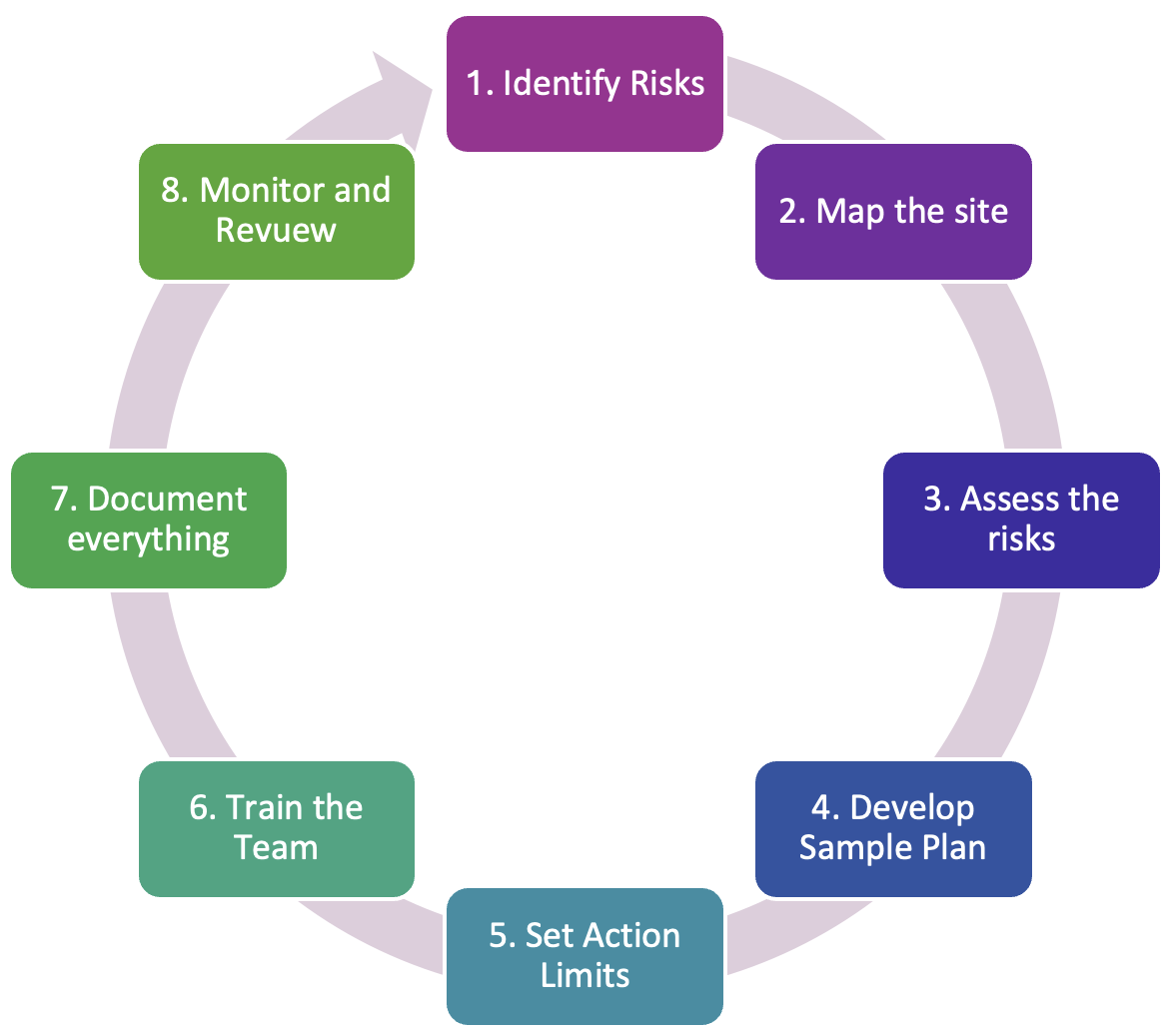
Let’s break down each step.
Step 1: Identify the Risks
Before swabbing a single surface, you must know where the dangers are hiding. Consider both external and internal sources.
- External & Incoming Risks:
- Raw Materials & Ingredients: High-risk materials can introduce pathogens. The area around raw material intake must be monitored to prevent pathogens from tracking into clean areas.
- Product Transport: Forklifts, trolleys, and pallets are mobile vectors. Identify where they travel and where they might pick up and deposit contaminants.
- Water Quality: Water is used for cleaning, as an ingredient, and in ice/steam. If untreated, it can harbour biofilms and bacteria. Your EMP must include water testing.
- Internal Environmental Risks:
- Equipment & Surfaces: Focus on ‘niche areas’—hollow rollers, cracks in boards, gaskets, and crevices where bacteria can hide from cleaning chemicals.
- Staff: People are often the primary source of contamination. Consider hands, gloves, and staff movement between areas zones.
- Drains: Often “enemy number one” for Listeria. They collect moisture and organic matter. High-pressure hoses can even aerosolise bacteria from drains onto production lines. Drains are a high-risk site
Step 2: Map and Zone the Facility
Draw a literal map of your facility and divide it into zones based on how close a surface is to the food product. This creates a hierarchy for your testing efforts.
- Zone 1 (The ‘Red Zone’): Product Contact Surfaces. These are surfaces that directly touch the food (e.g., slicer blades, conveyor belts, mixing bowls). This zone is the highest priority.
- Zone 2: Adjacent to Product Surfaces. Non-food-contact surfaces immediately adjacent to the food (e.g., equipment legs, machine casings, control panels). A splash or hand movement can transfer contamination from here to Zone 1.
- Zone 3: The Wider Processing Environment. Non-product contact areas within the production hall, such as floors, walls, and drains.
- Zone 4: Non-Production Areas. Locker rooms, hallways, maintenance areas. These show how pathogens might enter the production zones from outside.
How to Create Your Map:
- Conduct a walkthrough during normal operations to see the reality of water splash, dust, and people movement.
- Divide the facility into manageable areas (e.g., “Raw Material Hall,” “Line A”).
- Record specific risk sites within each zone. Be precise (e.g., “the leg of the red conveyor belt near the slicer”).
- The final output is a Site Map that guides your samplers to the exact locations every time.
Step 3: Assess the Risks
You can’t swab every site every day. You need to filter your long list down to the critical few by quantifying the risk.
Use the core formula: LIKELIHOOD × SEVERITY = RISK
- Likelihood: How probable is contamination at this site? (A drain is more likely than a wall panel.
- Severity: What is the consequence if it is contaminated? (A Zone 1 failure has high severity; a Zone 4 failure has low severity).
Score each site using these five criteria:
- Risk of cross-contamination: Can bacteria physically move from this site to the product?
- Condition of the surface: Is it worn, pitted, or rusty?
- Suitability and Age: Is the equipment outdated or poorly designed for the hygiene zone?
- Ease of cleaning: Is it reachable?
- Material and Construction: Is it food-grade (e.g., stainless steel vs. wood)?
This assessment assigns each site a Risk Score, which determines your monitoring frequency (e.g., high-risk sites weekly, low-risk sites monthly).
Step 4: Develop the Sample Plan
Now, build the operational plan. This document answers the questions: What, Where, When, and How?
- What are our targets? Your choice of targets (pathogens or indicator organisms) should be based on:
- Regulatory Requirements (e.g., R638 in South Africa, or EU requirements for exporters).
- Customer Requirements (often stricter than regulations).
- Product-Specific Requirements (e.g., Listeria for RTE foods, Salmonella for raw meat, Vibrio for raw fish, Yeasts & Moulds for dry goods).
- Finalise the Plan: Your Sample Plan document must include:
-
- Frequency and Justifications: How often you test each site, justified by its Risk Score from Step 3.
- Methods, Tools, and Skills: Specify the test methods (e.g., swabs, sponges), the tools needed, and confirm that staff are trained to use them.
Step 5: Set Action Limits
You need to define the ‘line in the sand’—the criteria that will trigger a response. This involves setting Alert and Action Limits.
- Alert Limit: An early warning. It indicates a trend that hygiene is slipping, but the site isn’t necessarily a safety risk yet. (e.g., a rise in TVC counts). This triggers a review of procedures.
- Action Limit: Indicates a failure. A pathogen is present, or indicator organisms are at an unacceptable level. This triggers an immediate, formal investigation.
Key Principle: Action limits should be more sensitive than acceptance criteria.
- Acceptance Criteria are often the legal limit—the point at which the product is unsafe.
- Action Limits are your early warning system, set well below the legal limit. You want to intervene while the environment is just ‘dirty’, before it becomes ‘unsafe’.
- Out-of-Limit Response Plan:
- For Indicator Organisms (e.g., high TVC): This is a hygiene failure, not an immediate safety threat. Do not just re-test. Investigate the cleaning process. Why did it fail? Find the root cause.
- For Pathogens (e.g., Listeria): This requires a comprehensive investigation to determine the source and extent. It must include an assessment of whether the product has been compromised, potentially resulting in a hold or recall.
Step 6: Train the Team
A plan on paper is useless if the people on the floor don’t know how to execute it. Training must be role-specific.
- The Samplers (Internal Staff): They need training on Sample Integrity and aseptic technique. They must know how to collect a sample without contaminating it and maintain the chain of custody.
- The Interpreter (Food Safety Manager/QA): They need training on data analysis and trend identification. They must be able to translate raw scientific data into actionable intelligence for the production team.
- Supervisors and Management: They need training on buy-in and feedback loops. They must understand the ‘why’ behind the swabbing so they can prioritise actions like stopping a line to deep-clean a drain. Management must use the data as a tool for improvement, not as a tool for punishment.
Step 7: Document Everything
In food safety, “If it isn’t written down, it didn’t happen.” Your documentation is your evidence.
Your documentation package must include:
- Sampling Plan and Maps: These are living documents. Update them as your facility or risks change.
- Documented Results and Trends: Don’t just record individual results. Track data over time to tell the story of your hygiene. Use trending to enable early detection of issues.
- Graph 1: Continuous Testing shows peaks and valleys, allowing you to react after a spike.
- Graph 2: Moving Baseline creates a ‘control zone’ of what’s normal. This helps you detect a slow creep upwards before it becomes a failure, moving you from ‘firefighting’ to ‘prevention’.
- Corrective Actions: When something fails, document the investigation and the fix. This proves you closed the loop.
- Training Records: Proof that your samplers are competent and trained on your specific methods.
Step 8: Monitor and Review
This is the engine of continuous improvement, connecting the end back to the beginning.
- Actively Monitor Trends and Review Results: Don’t just file reports. Look for patterns—recurring failures at a site, seasonal shifts in microbiology.
- Investigate Non-Conformances: Always perform a root cause investigation. Do not simply re-test.
- Act Upon Results—Both Positive and Negative: Act on failures, but also use consistent negative results to validate that your risk assessment and controls are working.
- Report Results to Management: Food safety is a management responsibility. Report results up the chain to ensure awareness and resource allocation.
- Update the Plan and Continuously Apply Core Principles: If monitoring reveals a new risk or if you change a product, update the plan. Your EMP must be a dynamic document that evolves with your facility. By completing this step, you don’t finish; you start the cycle again with better data and a safer facility.
Conclusion: Your Journey to a Safer Facility
Implementing a robust Environmental Monitoring Programme is not a one-time project; It’s a fundamental shift in how you view your facility, moving from relying on visual inspection to using scientific data. By following these 8 steps, you transform your EMP from a simple “audit box” into a vital diagnostic tool. You enable your team to see the invisible enemy, measure what you manage, and proactively protect consumers, your brand, and business. The rules are set, standards are clear, and the roadmap is here. The next step is yours. Start today.
For assistance with the development of your Environmental Management Programme, contact info@entecom.co.za
Moving Beyond Compliance to Proactive Food Safety Management
If you’re reading this, you’re likely familiar with the term Environmental Monitoring Programme, or EMP. This guide aims to consider EMP not only as a compliance requirement but also as a crucial diagnostic tool for your facility’s microbial health. Whether you are complying with the Department of Health’s R638 regulations, meeting Global Food Safety Initiative (GFSI) recognised standards like FSSC 22000 or BRCGS, or simply seeking to protect your brand from the risks of a product recall, understanding your food safety environment is vital.
In the following pages, we will go beyond theory. We will clarify what it truly means to monitor microorganisms in a food processing setting and provide a practical, 8-step plan to establish an effective programme.
Firstly, it’s important to recognise the changing landscape as the foundation of our prerequisite programmes (PRPs) evolves. ISO/TS 22002-1:2009 is has been replaced by two new standards.:
- ISO 22002-100:2025: The new generic PRP standard, aligning with Codex HACCP 2023 and expanding on validation, food defence, and food fraud.
- ISO 22002-1:2025: The sector-specific PRP standard for food manufacturing, adding detail for higher-risk areas like zoning, allergens, and rework.
Together, these form the new basis of PRP compliance. This guide will help you understand how to adjust your systems to stay ahead of these changes.
Let’s begin.
Part 1: The Foundation – Why We Can’t Rely on Our Eyes
The Invisible Enemy
Why sample the environment? A clean facility isn’t enough because pathogens like Listeria, Salmonella, and E. coli are microscopic and invisible. They don’t show signs like smell or colour, so a spotless look doesn’t guarantee safety. Traditional senses can’t detect them; scientific methods are needed to monitor and translate the invisible microbes into manageable data.
Consider this:
- Surface A and Surface B might appear identical after cleaning, both seemingly passing a visual inspection.
- However, a contact plate from Surface A could show a low microbial count—indicating it is truly clean.
- In contrast, a contact plate from Surface B might reveal substantial bacterial growth—a potential contamination hotspot, even if it looks clean.
Relying only on visual inspection is a trap. The only way to tell if a facility is ‘clean’ or ‘safe’ is through scientific monitoring. Without an EMP, contaminated surfaces could infect the product for weeks before the problem is detected.
Our key takeaway is this: The enemy is invisible. It is like boxing a ghost. We cannot manage what we cannot measure.
Therefore, our approach must be twofold:
- Control: We need robust procedures—cleaning, cooking, cold chain—to control bacteria.
- Verify: We must verify that those controls are actually working. That is the specific role of an Environmental Monitoring Programme. It is our proof that the invisible enemy has been defeated.
Part 2: The Rulebook – Where Do the Requirements Come From?
As professionals, we are guided by customer requirements, local regulations and international standards. The primary reference point for food safety globally is the Codex Alimentarius. When we design an EMP, we align with specific guidelines that ensure our approach is scientifically sound and legally defensible.
Four key Codex documents form the backbone of Environmental Monitoring:
- CXC 1-1969, General Principles of Food Hygiene: The ‘grandfather’ document. It establishes the foundation for GMPs and mandates that we must monitor the effectiveness of our sanitation procedures. Hygiene isn’t just about cleaning; it’s about verifying that cleaning works.
- CAC/GL 21-1997, Principles and Guidelines for the Establishment and Application of Microbiological Criteria Related to Foods: This provides the framework for establishing limits—what is acceptable and what is not. It guides us in distinguishing between testing food and testing the environment.
- CAC/GL 63-2007, Principles and Guidelines for the Conduct of Microbiological Risk Management: This is about decision-making. It helps you decide where to sample and what pathogens to look for based on the specific risk in your facility.
- CAC/GL 30-1999, Principles and Guidelines for the Conduct of Microbiological Risk Assessment: This provides the science for evaluating the likelihood and severity of adverse health effects.
In summary, an EMP is not a random activity. It is:
- A Hygiene Verification Tool (CXC 1-1969)
- Based on defined Microbiological Criteria (CAC/GL 21-1997)
- Built on Risk Management (CAC/GL 63-2007)
- Supported by Risk Assessment (CAC/GL 30-1999)
Part 3: The GFSI Benchmark – What the Top Standards Require
For those certified to GFSI-benchmarked standards like BRCGS or FSSC 22000, the expectations are even more specific. The release of the GFSI Benchmarking Requirements Version 2024 has updated these expectations, particularly in section FSM 19.
- FSM 19.1: Testing: Testing must be conducted using validated methods. In practice, this means your laboratory must be accredited to ISO/IEC 17025 to ensure results are accurate and defensible.
- FSM 19.2: Environmental Monitoring: This is the core. The programme must be risk-based, validated, and comprehensive, covering both pathogens (e.g., Listeria) and indicator organisms (e.g., Enterobacteriaceae).
- FSM 19.3: Cleaning and Disinfection Program: You cannot monitor what you do not clean. You must have a documented, validated cleaning programme. FSM 19.3 is the Control; FSM 19.2 is the Verification.
BRCGS Global Food Safety Standard, Issue 9
BRCGS v9 provides a logical, sequenced approach to EMPs.
- Clause 4.11.3 & 4.11.5 cover cleaning and the validation of cleaning efficacy. You must prove your procedures work before routine monitoring begins.
- Clause 4.11.8 is the explicit requirement for a documented EMP. It must include sampling procedures, locations, frequency, target organisms, and methods.
- Crucially, it requires Interpretation and Response. You must define Alert and Action Limits and have a predefined procedure for investigation, including Root Cause Analysis. The programme must be reviewed at least annually.
- Supporting Clauses:
- Clause 5.6 links to the integrity of lab analysis.
- Clause 8.4 requires you to use EMP to assess the effectiveness of footwear controls (e.g., swabbing boots).
- Clause 8.5 ensures that physical defects (like damaged drains) revealed by your EMP are repaired.
FSSC 22000, Version 6
FSSC 22000’s requirements are layered across its scheme documents.
- ISO 22000:2018, Clause 8.8 (Verification activities): This is the ‘mother clause’. Your EMP is a primary tool to prove that your hygiene controls (PRPs and CCPs) are effective.
- ISO 22002-100:2025 (New PRP Standard):
- Clause 6.1 (Water, ice, and steam): Requires monitoring of these utilities.
- Clause 6.3 (Air and ventilation): Implies the need for air sampling to verify air quality.
- Clause 6.4 (Compressed Air and Other Gases): A critical, often overlooked area. Requires monitoring to ensure compressed air used on or near the product is free from microbial contamination.
- FSSC Additional Requirements, Clause 2.5.7: This is the explicit mandate for an EMP. It requires a documented, risk-based programme that includes target organisms, a sampling plan, and, most importantly, trending and analysis. You must identify negative trends before they become a positive result on a food contact surface.
Part 4: The 8-Step Roadmap – Implementing Your EMP
Now that we understand the ‘why’ and the ‘what’, let’s move to the ‘how’. This is your practical roadmap, based on the 8 General Principles of Microbiological Risk Management from CODEX CAC/GL 63-2007.
This is a cycle. It’s circular because risk management is a continuous process of improvement.

Let’s break down each step.
Step 1: Identify the Risks
Before swabbing a single surface, you must know where the dangers are hiding. Consider both external and internal sources.
- External & Incoming Risks:
- Raw Materials & Ingredients: High-risk materials can introduce pathogens. The area around raw material intake must be monitored to prevent pathogens from tracking into clean areas.
- Product Transport: Forklifts, trolleys, and pallets are mobile vectors. Identify where they travel and where they might pick up and deposit contaminants.
- Water Quality: Water is used for cleaning, as an ingredient, and in ice/steam. If untreated, it can harbour biofilms and bacteria. Your EMP must include water testing.
- Internal Environmental Risks:
- Equipment & Surfaces: Focus on ‘niche areas’—hollow rollers, cracks in boards, gaskets, and crevices where bacteria can hide from cleaning chemicals.
- Staff: People are often the primary source of contamination. Consider hands, gloves, and staff movement between areas zones.
- Drains: Often “enemy number one” for Listeria. They collect moisture and organic matter. High-pressure hoses can even aerosolise bacteria from drains onto production lines. Drains are a high-risk site
Step 2: Map and Zone the Facility
Draw a literal map of your facility and divide it into zones based on how close a surface is to the food product. This creates a hierarchy for your testing efforts.
- Zone 1 (The ‘Red Zone’): Product Contact Surfaces. These are surfaces that directly touch the food (e.g., slicer blades, conveyor belts, mixing bowls). This zone is the highest priority.
- Zone 2: Adjacent to Product Surfaces. Non-food-contact surfaces immediately adjacent to the food (e.g., equipment legs, machine casings, control panels). A splash or hand movement can transfer contamination from here to Zone 1.
- Zone 3: The Wider Processing Environment. Non-product contact areas within the production hall, such as floors, walls, and drains.
- Zone 4: Non-Production Areas. Locker rooms, hallways, maintenance areas. These show how pathogens might enter the production zones from outside.
How to Create Your Map:
- Conduct a walkthrough during normal operations to see the reality of water splash, dust, and people movement.
- Divide the facility into manageable areas (e.g., “Raw Material Hall,” “Line A”).
- Record specific risk sites within each zone. Be precise (e.g., “the leg of the red conveyor belt near the slicer”).
- The final output is a Site Map that guides your samplers to the exact locations every time.
Step 3: Assess the Risks
You can’t swab every site every day. You need to filter your long list down to the critical few by quantifying the risk.
Use the core formula: LIKELIHOOD × SEVERITY = RISK
- Likelihood: How probable is contamination at this site? (A drain is more likely than a wall panel.
- Severity: What is the consequence if it is contaminated? (A Zone 1 failure has high severity; a Zone 4 failure has low severity).
Score each site using these five criteria:
- Risk of cross-contamination: Can bacteria physically move from this site to the product?
- Condition of the surface: Is it worn, pitted, or rusty?
- Suitability and Age: Is the equipment outdated or poorly designed for the hygiene zone?
- Ease of cleaning: Is it reachable?
- Material and Construction: Is it food-grade (e.g., stainless steel vs. wood)?
This assessment assigns each site a Risk Score, which determines your monitoring frequency (e.g., high-risk sites weekly, low-risk sites monthly).
Step 4: Develop the Sample Plan
Now, build the operational plan. This document answers the questions: What, Where, When, and How?
- What are our targets? Your choice of targets (pathogens or indicator organisms) should be based on:
- Regulatory Requirements (e.g., R638 in South Africa, or EU requirements for exporters).
- Customer Requirements (often stricter than regulations).
- Product-Specific Requirements (e.g., Listeria for RTE foods, Salmonella for raw meat, Vibrio for raw fish, Yeasts & Moulds for dry goods).
- Finalise the Plan: Your Sample Plan document must include:
- Frequency and Justifications: How often you test each site, justified by its Risk Score from Step 3.
- Methods, Tools, and Skills: Specify the test methods (e.g., swabs, sponges), the tools needed, and confirm that staff are trained to use them.
Step 5: Set Action Limits
You need to define the ‘line in the sand’—the criteria that will trigger a response. This involves setting Alert and Action Limits.
- Alert Limit: An early warning. It indicates a trend that hygiene is slipping, but the site isn’t necessarily a safety risk yet. (e.g., a rise in TVC counts). This triggers a review of procedures.
- Action Limit: Indicates a failure. A pathogen is present, or indicator organisms are at an unacceptable level. This triggers an immediate, formal investigation.
Key Principle: Action limits should be more sensitive than acceptance criteria.
- Acceptance Criteria are often the legal limit—the point at which the product is unsafe.
- Action Limits are your early warning system, set well below the legal limit. You want to intervene while the environment is just ‘dirty’, before it becomes ‘unsafe’.
- Out-of-Limit Response Plan:
- For Indicator Organisms (e.g., high TVC): This is a hygiene failure, not an immediate safety threat. Do not just re-test. Investigate the cleaning process. Why did it fail? Find the root cause.
- For Pathogens (e.g., Listeria): This requires a comprehensive investigation to determine the source and extent. It must include an assessment of whether the product has been compromised, potentially resulting in a hold or recall.
Step 6: Train the Team
A plan on paper is useless if the people on the floor don’t know how to execute it. Training must be role-specific.
- The Samplers (Internal Staff): They need training on Sample Integrity and aseptic technique. They must know how to collect a sample without contaminating it and maintain the chain of custody.
- The Interpreter (Food Safety Manager/QA): They need training on data analysis and trend identification. They must be able to translate raw scientific data into actionable intelligence for the production team.
- Supervisors and Management: They need training on buy-in and feedback loops. They must understand the ‘why’ behind the swabbing so they can prioritise actions like stopping a line to deep-clean a drain. Management must use the data as a tool for improvement, not as a tool for punishment.
Step 7: Document Everything
In food safety, “If it isn’t written down, it didn’t happen.” Your documentation is your evidence.
Your documentation package must include:
- Sampling Plan and Maps: These are living documents. Update them as your facility or risks change.
- Documented Results and Trends: Don’t just record individual results. Track data over time to tell the story of your hygiene. Use trending to enable early detection of issues.
- Graph 1: Continuous Testing shows peaks and valleys, allowing you to react after a spike.
- Graph 2: Moving Baseline creates a ‘control zone’ of what’s normal. This helps you detect a slow creep upwards before it becomes a failure, moving you from ‘firefighting’ to ‘prevention’.
- Corrective Actions: When something fails, document the investigation and the fix. This proves you closed the loop.
- Training Records: Proof that your samplers are competent and trained on your specific methods.
Step 8: Monitor and Review
This is the engine of continuous improvement, connecting the end back to the beginning.
- Actively Monitor Trends and Review Results: Don’t just file reports. Look for patterns—recurring failures at a site, seasonal shifts in microbiology.
- Investigate Non-Conformances: Always perform a root cause investigation. Do not simply re-test.
- Act Upon Results—Both Positive and Negative: Act on failures, but also use consistent negative results to validate that your risk assessment and controls are working.
- Report Results to Management: Food safety is a management responsibility. Report results up the chain to ensure awareness and resource allocation.
- Update the Plan and Continuously Apply Core Principles: If monitoring reveals a new risk or if you change a product, update the plan. Your EMP must be a dynamic document that evolves with your facility. By completing this step, you don’t finish; you start the cycle again with better data and a safer facility.
Conclusion: Your Journey to a Safer Facility
Implementing a robust Environmental Monitoring Programme is not a one-time project; It’s a fundamental shift in how you view your facility, moving from relying on visual inspection to using scientific data. By following these 8 steps, you transform your EMP from a simple “audit box” into a vital diagnostic tool. You enable your team to see the invisible enemy, measure what you manage, and proactively protect consumers, your brand, and business. The rules are set, standards are clear, and the roadmap is here. The next step is yours. Start today.
For assistance with the development of your Environmental Management Programme, contact info@entecom.co.za